Saturday, January 9, 2016

Animals of the Kruger. And others.

Following my last blog, and in response to a couple of queries, the Intercape bus was absolutely the best of the two, and I would recommend it if you ever have to travel by bus. The problems at the border were beyond their control, in in every aspect they were the better of the two companies.

(Newbies to my Blog can see old posts by clicking the titles in the Blog Archive at the top right of this page)

In keeping with my NY resolution to try and post at least once a week - herewith this week a glimpse of some of the animals we saw in the Kruger National Park over Christmas. All photos except one were taken on one day.

The kids developed their own modified game-viewing technique - and the heat we experienced made this a regular occurrence. I know I have posted this pic on my Facebook page before, but this is the first time it has appeared in a blog.


Not only did we have elephant in front of our house, but also the hippo who lived in the pools in the rapidly dying river. It had rained just before our arrival, and this photo was taken from the porch early in our stay. By the time we left, the river had almost completely dried up, and was flowing in just a trickle.


For me, the highlight was a sighting of my favorite animal. The facts that it is both rare and elusively shy at the best of times adding to my delight at seeing it in its natural environment. Quite easy to miss spotting these animals even when in plain view, my little camera did its best.

This photograph is titled 'A study in relaxation during the heat of the day'.


The Kruger, like most of Africa south of the equator, has not yet had the rains we are all craving, and so the waterholes were a magnet for the game. In this photo there are baboon, impala and a rhino with calf. This is an indication of the heat - she was shielding her baby from the sun with her own massive bulk.

The Kruger is one of the last places on earth that you can go to see rhino in appreciable numbers, and we saw many during our time there. They are the second-largest land mammal, and they are part of the Big 5. Because of the large quantity of fibrous grass that they eat, access to water is essential for digestion, and bulls that do not have water in their own territory will enter the territory of another bull to drink. These vital water-related intrusions are accepted by the resident bull providing that the intruder shows submissive behaviour. A bull rhino shows submission by urinating in a continuous stream, whereas in his own territory he would spray. (This would seem to suggest that a lot of male motorists in Zimbabwe on the open road are exhibiting submissive behaviour, but this is not the case. They are just having a wee)

Appropriately, the collective noun for a group of rhino is 'a crash of rhino'! How cool is that?


The largest land mammal is obviously the elephant, and they, too, were present in large numbers in the Kruger. They really are gentle giants, and can move deceptively quickly when they are making their way through the bush.

Any time that an elephant looks down on you, you know that you are kind of close to it. This is a solitary bull that was feeding close to the road, and we watched him until we were a safe distance past him. There have been instances in the past of elephant charging, and squashing, cars.
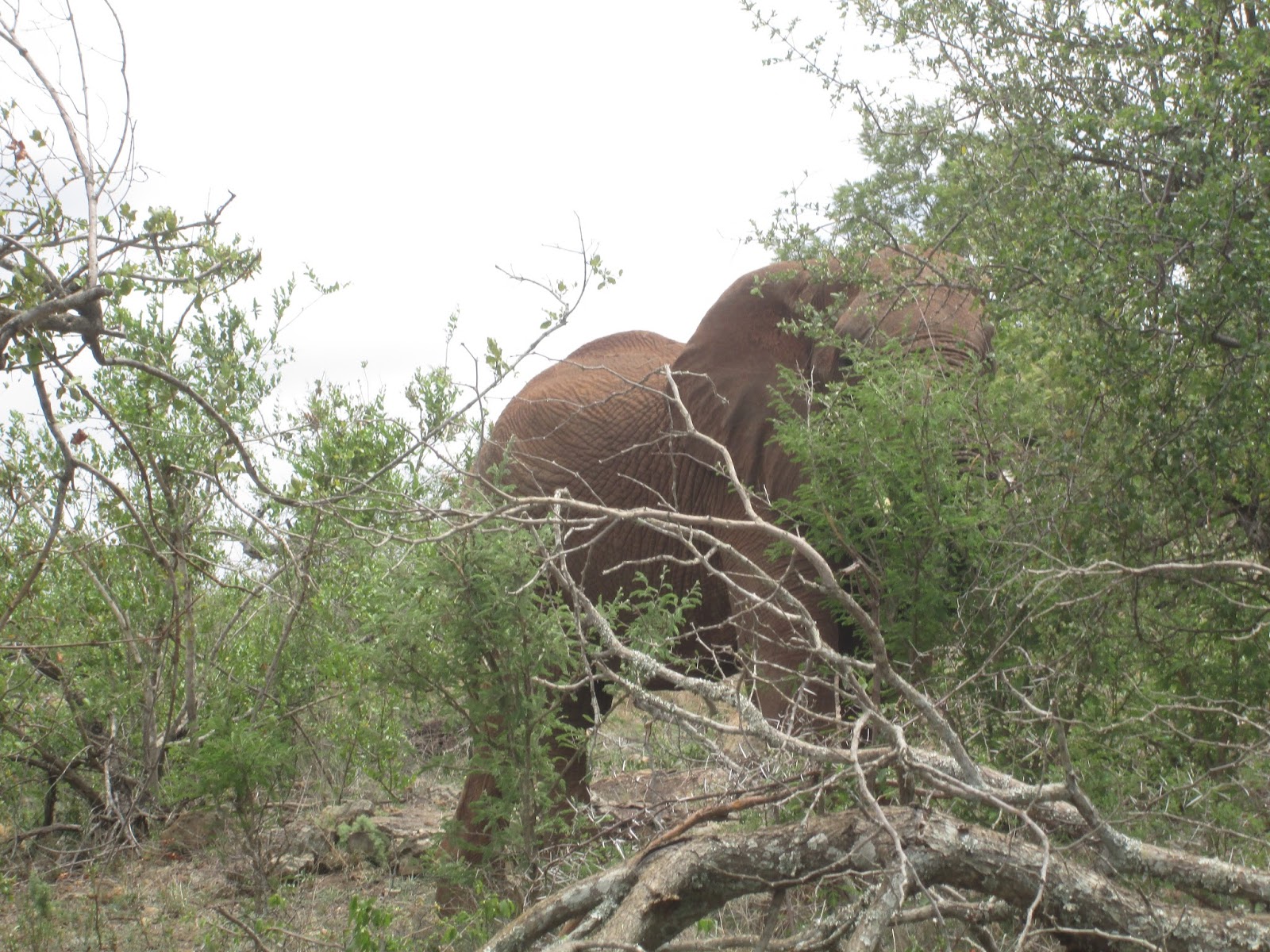

It is astonishing just how camouflaged elephants are in the wild. OK - if you put an elephant up against a white wall, they kind of stick out, but in the bush, despite their enormous  bulk, they very often just melt away, and it is only the flapping of an ear that reveals them. In the pic above, though the vegetation is sparse, his trunk and legs have disappeared. Amazing.

Now then - talking of camouflage - can you see the cheetah in the following photo? Taken at a distance of around 20 meters with my little point-and-click camera.


Of course, you were aware that the word 'cheetah' can refer either to a single animal, or more than one. So the question remains - did you see the cheetah in the photo? All 3 of them? Or just one of the pair on the extreme left? Or just the one to the right of center?

Finally - this strange and beguiling creature which appeared on Christmas Day - appearing just long enough to be photographed. It is the Greater Antlered Dannicus, and it was caught in the act of dispensing fodder and nesting material to members of its herd.

Shy and elusive, very rarely spotted more than once a year in most instances, it tends to congregate near centres of learning for most of the year.

The red antlers indicate it is a sub-adult male, and almost ready to breed.

Worryingly.


So there you go! The animals of my Christmas.

Have a great day, and please 'Share' the blog for me back on Facebook? Thanks.

Friday, January 1, 2016

Of buses, borders and African pedantry!

So - a Happy New Year to one and all!

And a resolution to try and post a blog at least once a week. I figure I have the time, and certainly the material. We'll see how we go.

I am going to start catch-up from the present working backwards, and this means our recent trip to South Africa to spend time with family. We had booked to fly down. This was going to be the first time on an airplane for Courtney, and we would be there in a matter of an hour or two. Unfortunately, the day before we were due to fly, the airline - flyafrica.com advised us they were not flying, and we had to make alternate arrangements.

Thanks, guys.

This meant catching a bus from Harare to Johannesburg - a trip of 24 hours each way on a bus - inclusive of 6 hours at the border. We went down by Greyhound, and back by InterCape.


 On the way down, we reached the border at around 06.00am - and spent 6 hours at the Beithbridge border post on the South African side. This meant that we were queuing in the mid-day sun to get into the Customs Office, and the only shade was that thrown by our double-decker bus. My family, troopers to the end, found something to smile about as they crouched on the pavement in temps of around 42C as they waited for something to happen:


On the way down, the bus was cramped and quite uncomfortable, which meant we basically fell into bed when we reached our family's Johannesburg home around midnight (after having made our way to the airport to collect a hire car which was waiting for us to come off a flight), some 33 hours after leaving home.The second bus was a lot more luxurious, and the family were delighted with the extra space for our knees, and the reclining seats. Here are 3 happy faces:


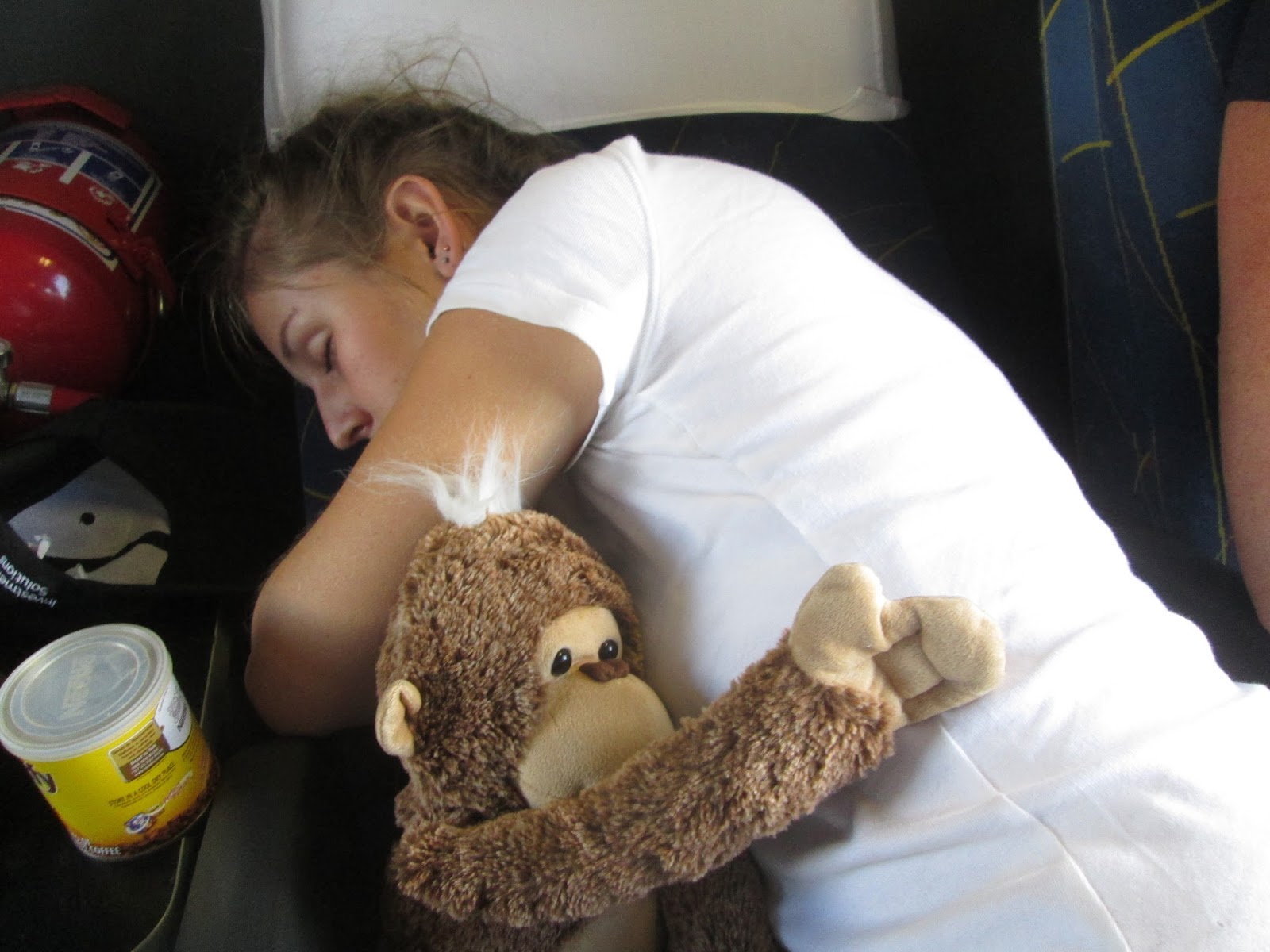
Of course, on such a long journey, the only options were to read, watch the scenery, or sleep. And if you have a friend to cuddle, well that makes it a choice of one:-


Then . . . . .  on the way home, we hit the Zimbabwe border post, where we spent another happy 6 and a half hours.

Part of the delay there was due to the fact that that process was three-fold - first join the queue to get into the Immigration building to have our passports stamped: we must have been at position 130 when we joined. Then secondly we had to join the line waiting to have our Customs Declaration form signed - there we joined at position 250, and by the time we reached the front, there were at least 500 people behind us. Then thirdly . . . . . the buses all lined up in a queue of their own, and came forward one by one for 'inspection'. This meant offloading the luggage trailers, and everyone had to stand by their own luggage, which was then opened by the tax Inspector - one at a time! There were roughly 30 buses each carrying 80 passengers - and one, yes ONE, Tax Inspector.

You can see him in the yellow safety vest shuffling through his papers, and this is just one bus being 'inspected'.


By the time we had been at the border for 6 hours, someone decided that enough was enough, and allowed our 'luxury' bus to continue on its journey - without the dreaded baggage inspection. That was a true blessing, and we were saved the ignominy of having our clothes and Christmas presents pawed through in search of contraband. We were truly fortunate to have only to have spent 6 hours there, and the sun was brightening the horizon as we pulled out of the border post.

It could have, believe or not, been an awful lot worse!

So now I can recount a moment of sheer African pedantry:- we had been in the queue about 2 and a half hours to have our 'customs forms' stamped - joining at around 11.00pm, and reaching the fellow sitting at a desk with a rubber stamp at around 01.30am. We had filled out our forms while standing in the queue, (resulting in some rather strange signatures) and when we reached the front, the Customs Officer refused to accept them because . . . . . . the date on them was wrong! We had joined the line on the 30th of December - which was when we filled out our forms, and we reached the front on the 31st December, so he wouldn't accept them until we had corrected them. Bear in mind I had moved about 200 places in the line, and at that stage there were around 500 people behind me waiting to get their own little blue pieces of paper signed, but the whole process ground to a halt because the dates were wrong. Ha ha ha - don't you just love Africa?

Me, being Mr Grumpy, changed the date with a black pen and an even blacker scowl:


All in all, we spent 6 hours at Beitbridge, obtained 1 stamp in our passport, and one on signature on a blue piece of paper. And nothing else. No-one inspected our luggage, collected our signed blue forms, or showed any interest in us whatsoever. For 6 and a half hours we either stood in the queues, or waited on the bus for it to move.

6 and a half hours.

For no apparent reason other than that the 'system' required it of us.

Anyways, I hope your New Year will be more productive, fruitful and enjoyable that my time at the border, and I wish you all the very, very best for 2016.

Cheers!


Monday, September 28, 2015

What a load of rubbish!

In common with most cities around the world, Harare has 2 faces - one pristine and the other slightly shabby and unkempt.

Today I have some photos of my new home which show just how much refuse collection and disposal has deteriorated in what used to be called "The Sunshine City". Our 'City Fathers' may well be accused of abrogating their responsibilities - but what do I know? You be the judge:

And I must admit that I am feeling slightly guilty at posting this blog because it shows Zimbabwe in the worst light (especially the last photo) - while I generally try and showcase the best and funniest we have to offer.

Apologies in advance for the sordid posting.

This may not be how all those very many folk living outside the country will remember Harare. It used to be a fairly pristine city, but has slowly deteriorated to a typically African urban scene:


So much easier to wade through it than pick it up? And - those who have gone - did you notice the Dairibord Icecream lady just intruding into the photo?

The following photo was taken of the vehicle that we used for shopping when I was at Pamuzinda. It is not staged in any way, and the trash piled at the wheels was there when we parked.


On one of the roads leading out of Harare, this is the sight that greets travelers:


This is the same road leading out of Harare - festooned with plastic. Most of the items pictured are plastic shopping bags and bread sleeves. And on the right of the picture you can see a newly-ploughed field, ready for planting in anticipation of the rains


And here is a picture of the same field - prepared just the day before, but now with a liberal smattering of plastic and other trash. The field is adjacent to the road pictured above.


So where was this road leading? Well, to the Wingate Park Golf Club, where I had the pleasure of a leisurely 18 last Friday.And the golf club is  situated right next door . . . . to the Harare Municipal Dump. Which is the source of all of the plastic blowing about the countryside in the preceding 3 photos!

The expansion of the dump towards the golf club has led to a rather unique golfing experience on a golf course which, while not top-drawer, is certainly a pleasant play. This is my friend Ben (who carded a fantastic eagle on this day) sending another bullet straight down the fairway - with a mountain of plastic in the background. A picture of the dump as seen from the Tee Box. The bulk of this is  . . . . plastic water bottles. Unbelievably.


A view not restricted to the tee boxes either.

A couple of the greens have found that the expansion of the dump has somewhat detracted from the views as envisioned by the original course architects:


And like rubbish dumps (or tips?) all over the world, the Harare Municipal Dump supports a parallel world - people who work, eat and sleep there, spending their days going through other people's leavings for a living. In the picture below you can see 3 of these 'gleaners' hard at work.


A bit like the 'spot the cat' picture, isn't it? Bet you missed the figure on the extreme left?

And now for a picture of some real rubbish.

For which I am solely responsible.

And I would just advise those of you with a nervous disposition to look away now, and page back to the top.

Because this is rubbish of the worst kind.

And it was seen all over the golf course!


So, there you have it

Rubbish . . . . . everywhere!

Have a great day.

Wednesday, September 23, 2015

Puppy for sale.

Today's blog is not in the normal flow of things because we have a puppy to sell.

Due to unforeseen circumstances, one of our puppies is now available. Most folk let pups go at 6 weeks, but I like to keep them to just under 8 weeks, and so Moto-moto will be ready for a new home by Tuesday 29th September. Cost is $300

This is the fellow now available:


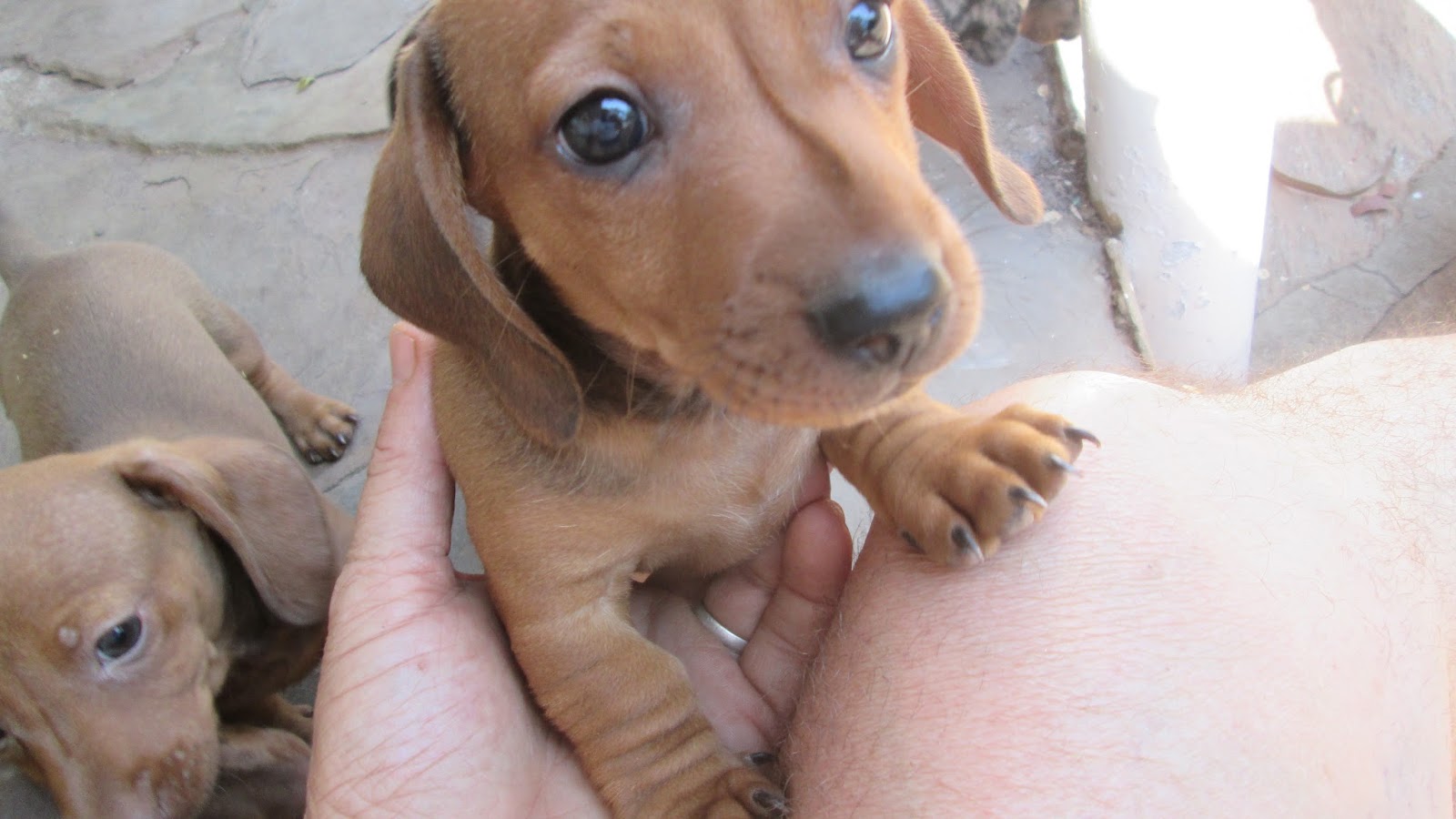
And another view of the little chap from close-up.

(This is him in a thoughtful mood!):


We call him Moto-moto (which means 'fire-fire' in Shona) because he is a very solid and strong little dog. Obviously his new owners will re-name him when they get him.

His Dad - Blue -is a dappled dachshund (daxxie) who was imported from South Africa. His mother is a brown daxxie, and her mum also came from South Africa - so lots of new genes to Zim. This is father & son:


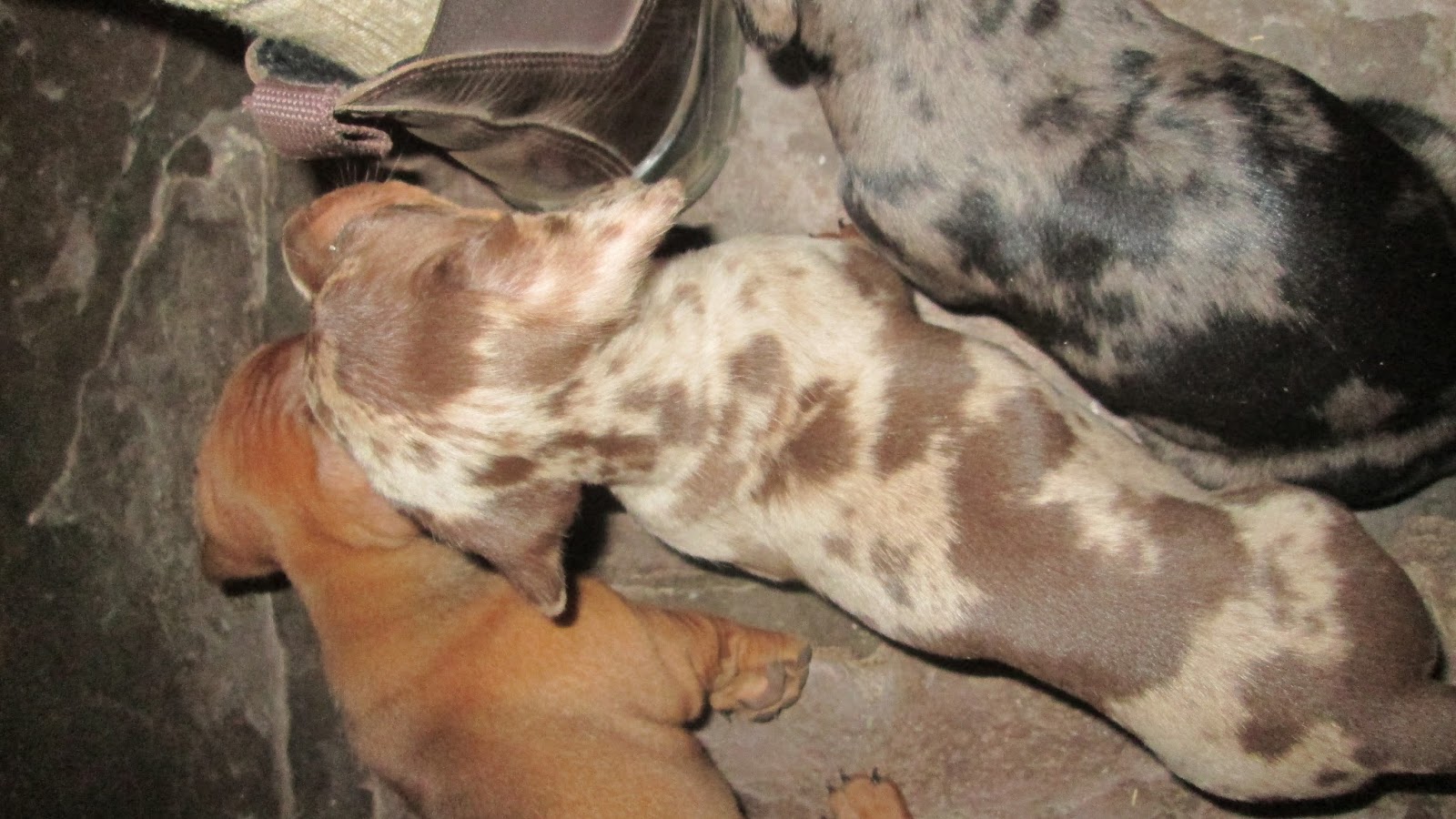
So what are the chances of Moto-moto producing a dappled offspring? Well the vet said he should carry the dapple gene through, but there are no guarantees. This is Moto-moto with his 2 dappled siblings:


 We had 2 dappled and 2 brown in the litter.

2 of the pups are staying in Zimbabwe, and the third is on his way to Zambia shortly.

Here are the kids trying a bone for the very first time. (They love bones!)


So there you have it.

If you are interested in a fine specimen of a daxxie and can give a home to Moto-moto, please give me a call on ?-263-(0)772306560. Thursday afternoon would be a good time to come around and see the pups if you are genuinely interested, or Saturday morning.

We will release him on a FCFS, COD basis.Obviously all jabs are up to date.

Or . . . . . . if you are already a daxxie convert (only special people own daxxies!), have a little lady to whom you are devoted and would like some puppies of your own, and if you would like Blue - Moto-moto's father, as a stud, again please give me a call. Stud fees will be either POL or equivalent.


One last look - at a homeless puppy in need of love and a good, safe, home. lots of licks assured! (Actually he is the waggiest-tail little dog!)


Fine fellow.

As always - new readers can go to the top of this page, and you will see all my old posts listed. The most recent ones anyway. there are 201 in total, all about life in Africa.

Have a great day!

Monday, September 14, 2015

Stars and stripes - and the end of a chapter.

On Saturday morning I resigned from Pamuzinda.

In the morning I tendered my resignation with 3 months' notice, but by late afternoon, after earnest and frank exchange of ideas, it was agreed that I would leave at once. On Sunday morning I rode through to Harare, and I am now back at home - the end of the chapter of my life at Pamuzinda. The nuts and bolts of why I resigned are not important, suffice to say that this means 3 things -

1) I am now seeking employment, so any suggestions welcome

2) There probably won't be too many more blogs on the wildlife of Pamuzinda/Chengeta. But the blog will continue.

3) I am now seriously getting under Della's feet!

I had one fantastic moment on my ride home to Harare, which I would like to share before getting into today's blog. I was parked at a service station having a coke for breakfast (as you do!) and a minivan pulled up next to me - full to the brim with morning commuters. Suddenly there was a loud Gaggglunkkk sound - as the side door fell off the vehicle. The passengers all ooooohed and aaaaahed - and the driver and his 'conductor' picked the door up and shoved it back into place - grinning all the while at the absurdity of their commercial public transport vehicle falling apart at the seams with paying passengers on board:


Yup - in Africa when things go slightly wrong, we laugh long and loud. At ourselves!

In no time at all they wrestled the errant portal back into place - and the smiles continued all the way. Notice also my trusty motorbike in the background. I had fortunately parked on the other side of the van from the falling door otherwise it could well have been crushed!


So that was the door story. Now for zebras.

Though I have left Pamuzinda, I had recently taken a couple of great zebra pics - and I figured that today the blog will be about stars (the bus guys) and stripes (zebras). Actually mostly about stripes.

Here are some interesting facts about zebra stripes:

Firstly, the stripes on a zebra are like a human fingerprint, and each zebra has a pattern of stripes distinctly different to every other zebra in the world. Kind of like snowflakes are all different; except zebras are bigger than snowflakes. You know?

Secondly, when a baby zebra is born, it 'imprints' the pattern of stripes on its mother - and can pick her out in a herd instantly.

Thirdly an answer to the age-old question - is a zebra white with black stripes . . . . . or black with white ones? Well if you shave all the hair off a zebra, the skin underneath is all black. So the answer is white-on-black.

Fourthly the patterns are thought to provide a 'dazzle' camouflage and make it difficult for predators to identify weak individuals, or indeed how many individuals there are in a herd.

And lastly zebras are able to consciously alter their stripes through carbonization. Not many people know this.

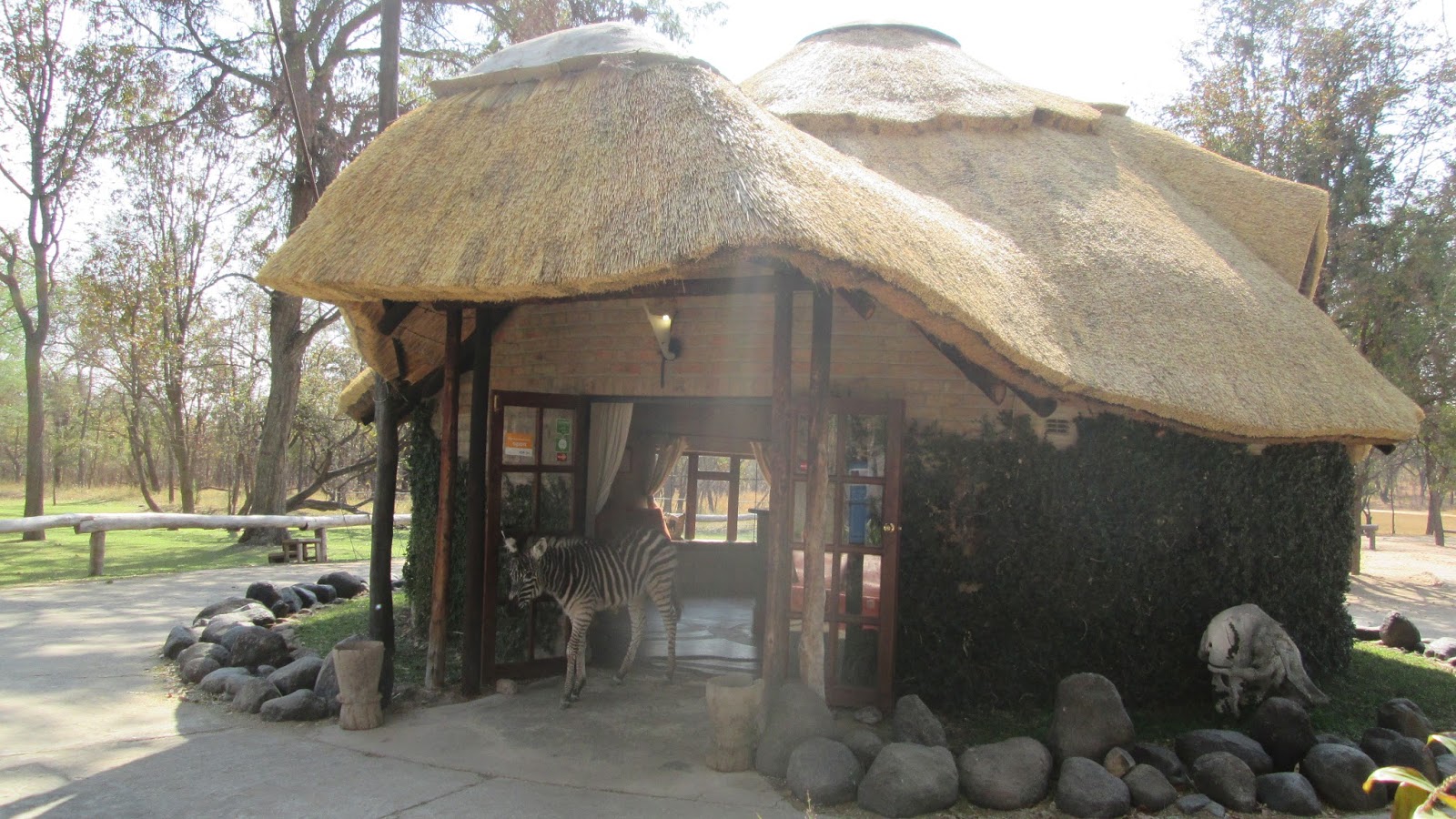
Those regular followers of the blog will know about Shungu the baby zebra. This is him paying a visit to Reception when he was much younger - just look at the stripes on his back legs!


Here is a zebra I photographed earlier in the year - at the start of winter, around June. Notice the light brown shading in the white stripes, as well as the dark stripes on the rear legs:


At this time of the year, having been through about 5 months without a drop of rain, Zimbabwe burns and there are fires everywhere as the vegetation is so dry. Also we are coming out of winter, and the temperatures are rising almost daily - and this is when one of the miracles of the bush takes place - the annual 'carbonization' of the zebras. Here is a herd of zebra that I photographed in a burned section of the park, right next to the road approaching Pamuzinda a couple of days ago:


What happens is that the zebras all congregate on the burnt patches of the veld, and eat the white ash left from burnt trees. As they do so, the carbon in the ash permeates their skin, and they lose their stripes - starting from the legs and moving up the body. This helps them because as they become lighter and whiter, their bodies reflect more light and heat, and they are able to keep cooler.  This is known as 'self-carbonization'. Their necks are the last to turn lighter (you will see in the pic above that their necks are definitely darker as they have not yet carbonized). At the same time, the white stripes on their bodies become broader and the black ones slimmer, and they lose the light brown shading. A really clever trick, no?

So in winter the black stripes are broader and darker to help absorb heat, and in summer the white stripes are broader in order to reflect heat and light.

Compare the legs on these zebras (especially the front one) to the previous photo taken in June . . . .


That is one of my best zebra pics from Pamuzinda!

So what happens if the zebras all eat too much wood ash? Well it is actually quite serious, because they develop a peculiar wooden gait, and stand stock-still, staring into space with vacant eyes . . . .


OK - so maybe I stretched the truth here - did you catch me out? This is a wooden zebra - and there is no such thing as 'zebra carbonization' either! Hope you didn't believe that as well? Zebras eating wood ash to get whiter? Ha ha ha ha!

As I state at the top of the blog - content is 'almost all true'. Today's fun-fibs were actually especially for Sue - who told her friends that 'most' of what I write is true.

However all the other statements and facts in the blog are true. I have genuinely left Pamuzinda, and am seeking alternate employment, so please 'share' this blog on Facebook for me. Maybe someone out there has something for me?

Have a great day!

Monday, September 7, 2015

The day the zebra ate my homework!

Welcome to the 200th blog-post from Zimbabwe. For those who are new to the site, older posts can be found at the top right of this page. And if you enjoy reading the blog - there is a button at the top of the page marked "Follow". Click on that and you will be notified every time I post.

Those who have been here before will know Shungu the baby zebra - and this is the story of the time he ate my homework!

Shungu (whose name means 'guts', or 'heart' or 'spirit' in the local Shona language) had the misfortune to be born on the same day that 2 stallions were taking over a herd, and because he was not their genetic material, and further because he would be future competition for mares - they tried to kill him. He was viciously kicked and bitten and would  definitely have died had we not rescued him. He suffered horrendous wounds, and can never re-join the herd.

About 4 months old now, he is fully healed, he stays in our stables with our horses. He spends some of his day at Pamuzinda, occasionally visiting the Reception Office:


My desk in Reception is located at the back, behind the counter, and he has learned that I am to be found there, so he visits me whenever he passes by. Like one of my kids popping in to see me!


He tends to nibble at stuff as he goes - checking to see what is edible or not. I guess this role would normally be filled by his mother, but as he doesn't have one, he is on his own. I certainly don't want to crawl around eating grass and showing him the best leaves and shoots to snack on!

Here he is testing a chair for edibility . . . .


He eased closer to the desk, and nuzzled me before he started to sniff at everything on my desk. Like a horse, grabbing and squeezing his upper lip releases an endorphin, and he also loves having his head scratched. Like all children he loves having an occasional 'snuggle'. However I was busy getting shopping orders ready, so I ignored him and went back to fighting with my Outlook Express - a battle I wage daily with not much success.

This was the opportunity the crafty little zebra had been waiting for . . . .


The next thing I knew he was chewing contentedly on my paperwork! I was so shocked that I only managed a quick snap - (which came out slightly blurred with my little point-and-click camera), before rescuing the bulk of the paper before he really started chewing:


So what did he eat? Well, I had been preparing to go to Harare for a couple of days break, and had been trying to leave instructions for the shopping trip the following Thursday. Most of my orders go to companies we deal with weekly - so I draw up emails and send them off for quotations. But this week I had needed some stuff on a one-off basis, and had scribbled notes (and a seriously good diagram) explaining what the guys would have to search for in Harare.


So that was the day the zebra ate my homework. Seriously.

As I didn't have time to write it out again, I left instructions for the staff to keep an eye out for the missing bit to re-appear the following morning, and I placed a roll of scotch tape in a prominent position on my desk, so they could re-attach it as and when it surfaced. Or rather - dropped into view.

Just another day at Pamuzinda.

Have a great day!

Friday, September 4, 2015

Spit on the roast! Another wedding at Pamuzinda.

So - another wedding at Pamuzinda, and this time on a Tuesday. How cool is that for an idea?

Here is our wedding chapel - with the Lodge in the background. Among other things.

Located on the island in front of the Pamuzinda, it is certainly one of the most scenic venues for a wedding. . . .in the whurld! (With apologies to Jeremy Clarkson). The aisle is made entirely of rose petals, and there is a serene beauty to the whole set-up.

No?


The morning was a busy one for the waiters, but by mid-day we had everything laid up and ready for the Reception. The heat is kicking in now in Zimbabwe, and we just got away with the flowers - the decorator spraying them with a mister until the heat of the day had passed.

Snappy?


The deck overlooking the river - featured in an earlier Blog titled "Views from a deck", was the setting for the Wedding Dinner. This photo is a little blurred, but gives an idea of the space we used looks like at night:


So just before the guests arrived, the candles were lit and everything took on a warm glow.


And now a little on the food.

As I do!

For the canape session after the ceremony, we spent an inordinately large amount of time prepping, but I think it turned out OK. We did vol au vent pastry cups filled with mushrooms in a brandied cream, rare roast beef on herbed bruschetta topped with English mustard and cream cheese, beef samoosas, and herbed crepes rolled with smoked salmon mousse.

And it turned out ok, if I say so myself! Whaddya think?


That's them nibbly bits.

The cake was once again surrounded by smaller cupcakes - this time topped with fresh strawberry, lemon, or macadamia nuts. I always love seeing the cakes (and had absolutely nothing to do with their production) - so much thought and attention goes into them:


For the main course, we did chicken in a tomato, olive and feta cheese sauce. And . . .  a spit-roast impala.

While the chicken took a while to prepare and cook - the impala was a week-long process. It started about 8 days before the wedding, when we shot the impala, and hung it in our cold-room. (Here I think I should mention that we didn't use a crossbow or and American dentist in the process. And we selected an old male ram with no name).

The day before the wedding, I first of all made holes in the legs and shoulders of the impala, and pushed in cloves of garlic. I then started basting the carcass every hour with a mixture of oil (sunflower), mixed herbs, white wine and Aromat. On the morning of the wedding, actually around noon, I seared the meat over really hot coals for about 10 minutes, and then let the fire die down. In the meantime I skewered the carcass, and wrapped it tightly in silver foil . . .


Once I had wrapped the impala in foil, it was suspended over hot coals for 6 hours, and turned constantly. The baste stayed in the foil, and because we kept it turning the whole time, it came out beautifully moist, but cooked through perfectly.We had lots of very positive comments on the spit-roast impala at dinner that night - something I don't think is served at too many weddings. As an accompaniment I had Rosella Jelly - which I found hiding among the jellies and sauces at TM Borrowdale. Really yummy accompaniment to Game meat.

Yup - we nailed it!

And as the foil kept the meat moist, I kept my spit turner moist with copious glasses of Mazoe and water. Regular readers of this Blog will recognize my 'manual-spit-turning-system'. It is actually Akim - who last featured in this blog walking along the top of our restaurant roof clutching a fire extinguisher to put out the blazing roof thatch. (Past blogs can be found at the top right of this page - all 200 of them). If we have stuff to do with fires, he is my go-to guy!


Obviously our usual band of suspects attended the wedding - without an invite. As is their custom. I guess they come for the snacks and the party, but their dress sense often leaves a lot to be desired. Mixing stripes and spots is something that is not normally recommended. But at an "African-themed" wedding - I guess it is allowed.


Did you see the ellies in the background? Cool beans.

The music for the canape session while the Bride and Groom went for photos - in keeping with the African theme, was provided by a Marimba band:


Finally - the question of how the bride arrived at the island? Well I was in the kitchen at the time and missed the actual delivery, but here are her delivery vehicles returning to base after a successful (and dry!) drop-off . . .


Once again our Team sorted a wedding out with aplomb. If you know anyone looking for a wedding venue with a difference - give Kylie a call at Pamuzinda.

I will try and post another blog or two on weddings we have done in the past couple of months.

Have a great day!